Every output traced to its clause and evidence
Your engineers should be designing products. Not assembling evidence.
ForgeComply is the AI execution layer for compliance in regulated hardware. Replace 6-figure consultancy bills with software output in days.
30 minutes, no pricing pitch. We open a handful of design-partner seats each quarter.
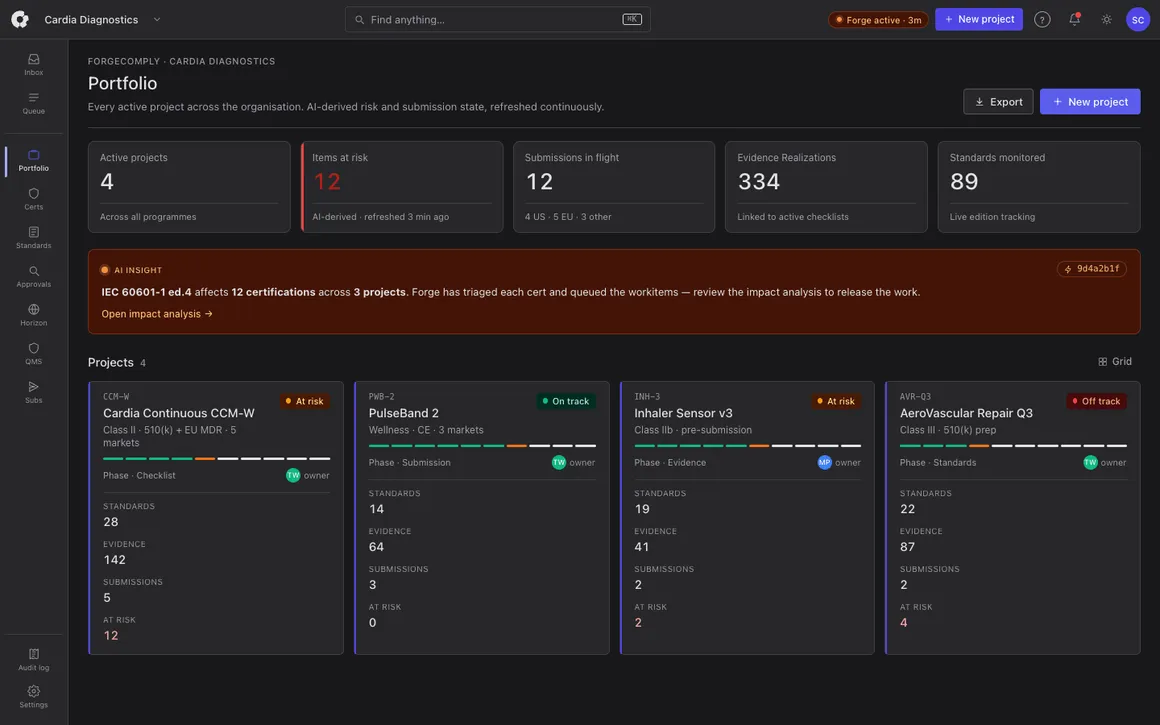
Hero dashboard capture · dark theme · demo data
What is ForgeComply?
ForgeComply is an AI compliance-execution layer for regulated-hardware engineers. It maps applicable standards clauses (FDA 21 CFR 820, ISO 13485, IEC 62304, ISO 14971, EU MDR) to your product context, drafts evidence, and flags gaps — turning submission prep from quarters into days. It’s your Quality team’s co-pilot, not a replacement.
The problem
Compliance is a velocity tax on your engineering org.
Your best engineers lose 20–30% of their capacity to evidence assembly. Chasing documents. Re-tracing requirements. Reformatting the same test report for a third regulator. None of it is engineering.
Each submission burns $200–400K and 6–18 months — most of it spent on analysis a machine can now do in hours.
And nothing you own fixes it. Your QMS stores files; it can’t reason over them. Point solutions nibble at the edges — one manufacturer spent $2M on a labelling fix that failed. So the work lands where it always lands: on engineering.
“Our sustaining team only manages regulation fixes and updates. The higher-value work never happens.”
— Director of Systems Engineering, multi-site medical device manufacturer
“Six figures to consultants on every submission — just to understand the requirements and analyse our own evidence.”
— Compliance lead, regulated hardware company
The stakes
The cost of doing nothing.
of engineering capacity lost to compliance work
per submission in consultancy and internal cost
per submission timeline, much of it analysis wait
From discovery interviews with engineering and quality leaders at regulated-hardware companies, 2025–26.
ForgeComply turns that into software output in days.
Day one
A filing date, not a blank workspace.
Forge reads the product, not the files. Connect what you already have — certifications, standards, evidence, product documents. Forge builds a live graph and runs a day-one health check across it. Then it does what no consultant will on day one: it commits to a date.
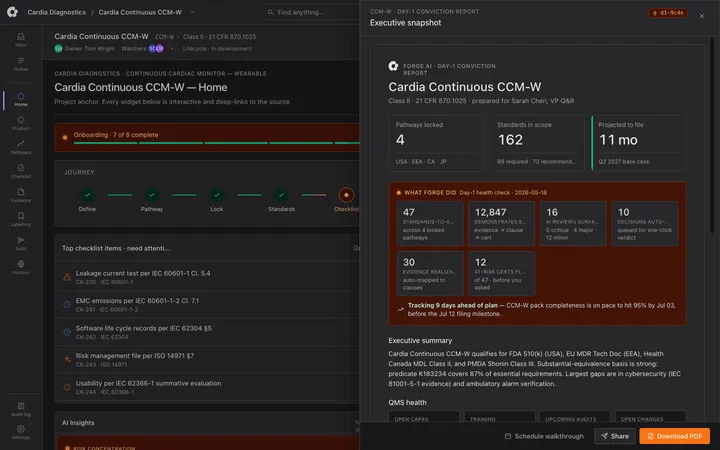
Day-1 Readiness Report · dark theme · demo data
Every day
AI does the reading. Your team keeps every verdict.
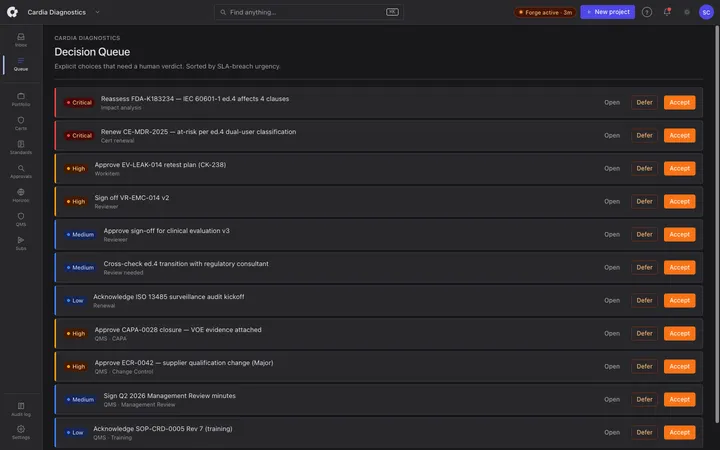
The Decision Queue · dark theme · demo data
Forge reviews evidence, drafts gap closures, maps clauses, and watches your portfolio around the clock. Nothing changes state on its own. Everything the AI wants to do lands in a Decision Queue — one-click verdicts, every action attributable and audit-logged. Your Quality discipline, at machine speed.
- Seven kinds of typed AI finding
- PR-style sign-off before evidence finalises
- 21 CFR Part 11 audit trail + e-signatures
How every output is verified
Checked by an agent. Signed off by a human.
Every output is built to move through the same three stages before it reaches you — each stage logged and attributable.
- 1
Forge generates
The AI drafts the evidence, mapping, or gap analysis from your product context.
- 2
A checking agent is built to verify
An independent agent is built to review every output against the source evidence and the applicable standard, flagging anything unsupported before it reaches you.
- 3
Your team signs off
A qualified person reviews and approves. Nothing finalizes without human sign-off.
Nothing reaches you unchecked. Nothing ships without sign-off.
The honest comparison
Why not just use your QMS — or ChatGPT?
| Dimension | Legacy QMS | Generic AI | ForgeComply |
|---|---|---|---|
| Knows your product | Stores your files — can’t reason over them | No product context at all | Reasons across your live product graph |
| Standards analysis | Templates and checklists you fill in | Plausible text; hallucinated clauses | Clause-by-clause mapping, traced to evidence |
| Drafts evidence | No | Unsourced drafts you can’t submit | Drafts linked to requirements and tests, reviewed by your team |
| Where it fits | System of record — and it stays that | A chat window beside the work, not inside it | The reasoning layer between your context and your submissions |
| Audit trail | For documents | None | Every AI action logged and attributable |
All three will live in your stack. Your QMS stays the system of record; ForgeComply is the layer that reasons.
When the ground moves
A new edition drops. Forge has already walked your exposure.
Horizon scanning watches the regulatory sources continuously. When a standard changes, Forge walks the dependency graph — standard → evidence → certification — and triages every affected cert: still valid, retest, notify, or resubmit. Reasoning shown, down to the clause and the exact test it invalidates.
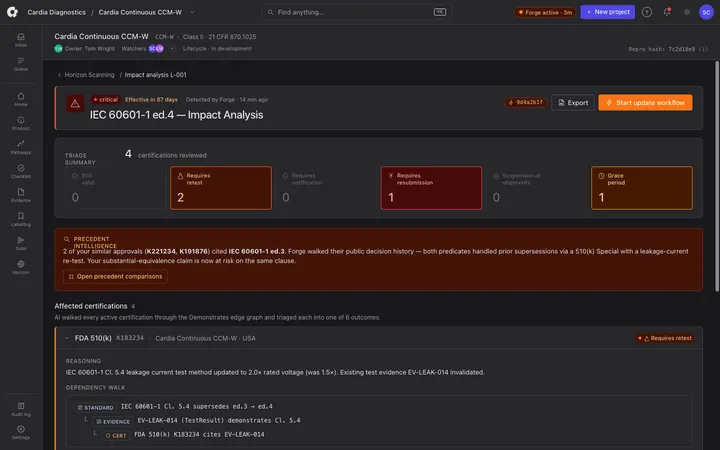
Impact analysis · dark theme · demo scenario
Prior approvals
What did regulators clear before you?
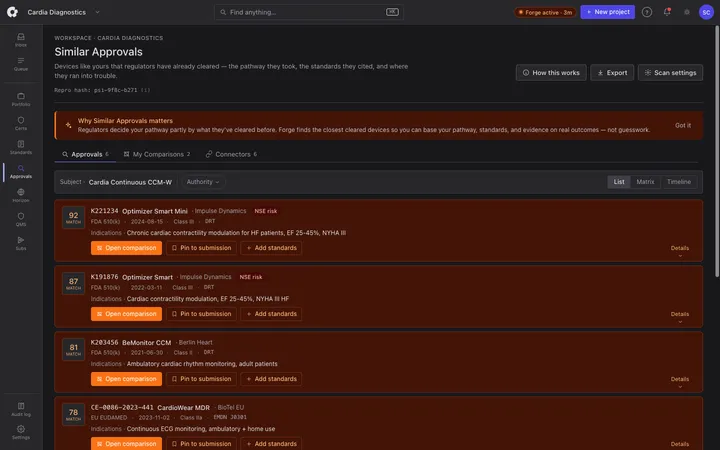
Similar Approvals · dark theme · demo data
Devices like yours have already been cleared — the pathway they took, the standards they cited, where they ran into trouble. Forge scans the public record (FDA 510(k), EUDAMED and more) and matches the closest cleared devices, so your pathway is based on real regulatory outcomes, not guesswork.
One medtech engineer described the job as reviewing past FDA assessments to decide how to bring a product to market. Forge does that reading for you — and keeps doing it as the record grows.
And the machine around it.
One product graph underneath — requirements, risks, tests, suppliers, standards — with the operational depth your Quality team expects on top:
-
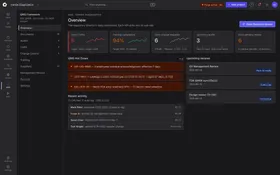
Enterprise QMS · dark theme · demo data
Enterprise QMS
CAPA, management review, change control, training — Part 11 audit trail throughout.
-
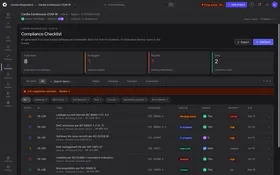
Per-clause checklists · dark theme · demo data
Per-clause checklists
AI-generated, evidence-linked, owner-assigned gap analysis.
-
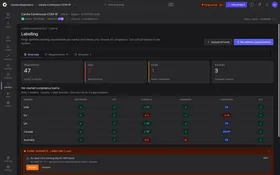
Labelling · dark theme · demo data
Labelling
Market-by-market labelling requirements traced to evidence.
-
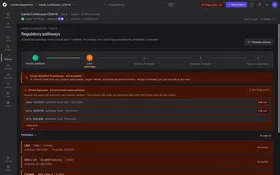
Regulatory pathways · dark theme · demo data
Regulatory pathways
Route-to-market analysis per target market, locked and tracked.
Before you book
Questions engineers ask before a demo.
Is the FDA accepting AI-assisted documentation?
Does this coexist with our QMS and PLM?
What’s your validation posture?
How is our data isolated?
Who’s using it today?
What actually happens in a demo?
Going deeper
-
Regulatory horizon
What’s changing next quarter
Deadlines and standard revisions we’re tracking, triaged for regulated-hardware teams.
-
Compare
ForgeComply vs consultancy-led submission prep
Where software output replaces the 6-figure engagement — and where it doesn’t.
-
Standards
The clauses we track
IEC 60601-1, IEC 62304, ISO 14971, ISO 13485, EU MDR — as an engineer reads them.
Compliance, automated. Engineering, freed.
30 minutes to see whether ForgeComply fits your stack and your submission timeline.
Optional: tell us about your product and timeline — . We’ll only use this to arrange the demo.